




|
|
||
|
|
|
|
|
|
||
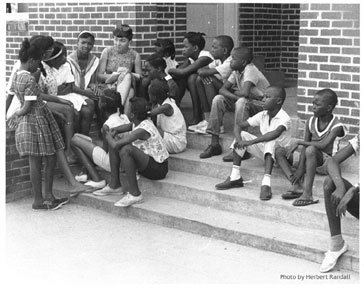
Photo: “Freedom School class at Mt. Zion Baptist Church,”
by Herbert Randall, 1964
Provided by the McCain Library and Archives, University of Southern Mississippi
Reprinted with permission of Herbert Randall
FREEDOM SCHOOL CURRICULUM
MISSISSIPPI FREEDOM SUMMER, 1964
Edited and Introduced by
Kathy Emery, Sylvia Braselmann, and Linda Reid Gold
In this website we attempt to assemble all the curriculum material that was written for and during Mississippi Freedom Summer. We have written an introduction to put the curriculum and the schools in historical context. Embedded in the introduction are links to supporting documents about Freedom Summer and the schools.
Assembling the “complete” Freedom School Curriculum was a difficult task, and we were not completely successful for two reasons. First, the curriculum was never one complete document or set of documents. Each part was written by different people from different organizations and submitted at different times. Some of the sections of the curriculum were distributed directly to the Freedom School teachers and some of the material was provided only to the local Freedom School coordinators. As you will see, we have not been able to find all these documents and at other times we assume that what we have inserted was what was used. We have taken to heart Casey Hayden’s advice to us that, “Things changed pretty fast, and the various drafts which you have, and the papers which seem to have materialized out of previous lists, are probably beyond anyone’s memory, and possibly beyond reason, so if you just make your best guesses about what turned into what on the lists, I feel pretty sure you will be providing the best guesses available” (personal correspondence with authors, 4/8/04).
Second, pieces of the curriculum were added during the summer in response to the need in the schools, and some of the teachers wrote their own material. One can argue that the curriculum’s central premise, the importance of questioning and connecting the material to the student’s life, challenged the concept of a written curriculum. The Freedom School curriculum encouraged—in fact, mandated—that the teacher improvise. Staughton Lynd suggested to “include any chunks of material that you can lay your hands on as items that were written for the Freedom Schools, and may have been used by at least some teachers” (personal communication with authors, 3/3/04). We followed that advice, but did not, however, include fairly extensive collections in the SNCC papers of material used in an English project in some schools.
In general, we have tried to recreate the curriculum as it was described in the Table of Contents on the cover page of the mimeographs distributed to the teachers. At the places that seemed appropriate to us we have inserted curriculum material that arrived later, or was written during the summer. The introductory documents were chosen to give the reader an overview of Freedom Summer as well as the plan and concept behind the curriculum and the schools. We have also included some reports and work of students.
Our source for all documents and the curriculum itself are the SNCC and MFDP papers (located at the King Center, Atlanta, and available on Microfilm in many University Libraries) and the Iris Greenberg Papers at the Schomburg Center for Research in Black Culture, New York. Every part of the curriculum will be annotated exactly as to where it can be found in these collections. In retyping the documents, we have corrected obvious typing errors, but have otherwise left appearance and layout as close to the original as possible.
Although this collection of curriculum material is copyrighted by us we do not claim authorship of anything but the introduction. We encourage everyone to print any part of interest and use it for teaching or research purposes and nonprofit use.
Recommended resources:
We are publishing the Freedom School Curriculum because we think that it is a timeless example of a progressive curriculum successfully implemented. While a superb model, the curriculum was, nevertheless, a very specific response to a unique historical period out of which its aims were generated. We provide only the briefest outline of this context in our introduction. We strongly recommend that you read more about Freedom Summer.
In September 2008, Common Courage Press published our book that provides historical context and lesson plans for the Mississippi Freedom School Curriculum, Lessons from Freedom Summer: ordinary people building extraordinary movements. Our book is intended to be a companion to the original source material on this website. Howard Zinn wrote in the foreword to our book:
In recounting the history of the Mississippi Freedom Summer of 1964, and the extraordinary experience of the Freedom Schools, this book does more than suggest a different view of history. It presents a unique approach to education, one that is not the outcome of abstract theorizing, but that has been forged out of a rare educational experiment, carried out, unbelievably and yet necessarily, in the midst of an ongoing social struggle.
The Freedom Schools were a challenge not only to the social structure of Mississippi, but to American education as a whole. They began with the provocative suggestion that an entire school system can be created in a community outside the official order, and critical of its suppositions.
That experience, and this book, ask questions which get at the heart of what education should be about. Can we, somehow, bring teachers and students together, not through the artificial sieve of certification and examination but on the basis of their common commitment to an exciting social goal? Can we solve the old educational problem of how to teach children crucial values, while avoiding a blanket imposition of the teacher’s ideas? (The key to that, suggested in the pages that follow, is in asking questions rather than arrogantly giving answers.)
Some of the websites recommended below have extensive bibliographies. For a quick overview we recommend the following resources:
Books:
1. Dittmer, John. Local People: The Struggle for Civil Rights in Mississippi. Chicago: University of Illinois Press, 1994. Dittmer’s book is a comprehensive story of the Mississippi civil rights movement and excellent in putting Freedom Summer into this context.
2. Sutherland Martinez, Elizabeth, ed. Letters from Mississippi. Brookline: Zephyr Press, 2002. This is a collection of letters sent by Freedom Summer volunteers, grouped and annotated by Elizabeth Sutherland Martinez, and a foreword by Julian Bond. It is a very good first person account of the events of Freedom Summer, seen through the eyes of the northern volunteers.
Articles (a few articles have been written about the Freedom Schools specifically):
1. Perlstein, Daniel. “Teaching Freedom: SNCC and the Creation of the Mississippi Freedom Schools.” History of Education Quarterly 30 (Fall 1990): 297-324.
2. Chilcoat, George W., and Ligon, Jerry A. “Developing Democratic Citizens: The Mississippi Freedom Schools as a Model for Social Studies Instruction,” Theory and Research in Social Education (XXII:2, Spring 1994, 128-175).
2. Chilcoat, George W., and Ligon, Jerry A. “’Helping to Make Democracy a Living Reality’: The Curriculum Conference of the Mississippi Freedom Schools,” Journal of Curriculum and Supervision (XV:1, Fall 1999, 43-68).
3. Chilcoat, George W., and Ligon, Jerry A. “We Will Teach What Democracy Really Means By Living Democratically Within Our Own Schools,” Education and Culture (XI:3, Spring 1995, 1-19).
4. Chilcoat, George W., and Ligon, Jerry A. “Theatre as an Emancipatory Tool: Classroom Drama in the Mississippi Freedom Schools,” Journal of Curriculum Studies (XXX:5, 1998, 515-543).
6. Rachal, John R. “We'll Never Turn Back: Adult Education and the Struggle for Citizenship in Mississippi's Freedom Summer.” Adult Education Quarterly 40, no. 3 (May 2000): 166.
Websites:
Civil Rights
Movement Veterans: http://www.crmvet.org/
This a great resource for
bibliography, links, stories of people working in the southern civil rights
movement, a list of speakers, and current announcements
3. University of Southern Mississippi Digital Archives
Music:
Voices of the Civil Rights Movement: Black American Freedom Songs 1960-1966. Smithonian Folkways CD SF 40084. Some of the volunteers have said what they remember most vividly of Freedom Summer is the singing. This two CD set (43 songs) contains recordings of mass meetings and of the many ensembles that were created during the Southern Civil Rights movement. The enclosed booklet, written by Bernice Johnson Reagon, provides an excellent introduction into the role of African American musical culture in the civil rights movement, and explains many of the songs.
Photos:
Randall, Herbert. Faces of Freedom Summer. Tuscaloosa: University of Alabama Press, 2001.
Acknowledgements:
Lois Chaffee, co-chair of the Curriculum Planning Committee, clarified the sources of the curriculum.
Staughton Lynd (statewide Freedom School Coordinator during Freedom Summer) and Liz Aaronsohn, (previously Liz Fusco, statewide Freedom School Coordinator for the two years after Freedom Summer) gave us permission to reprint articles they have written on the Freedom Schools.
Herbert Randall gave us permission to use some of his photos of Freedom Summer on this website; Howard Zinn and Martin Duberman gave us permission to reprint excerpts of their work.
Howard Romaine, Mitch Zimmermann and Chris Joslyn gave us legal advice.
Jan Hillegas provided access to her collection of Civil Rights documents, and many movement contacts.
Casey Hayden, Mendy Samstein, Jane Stembridge, Dave Dennis, Charlie Cobb, Helen Garvy, Tom Hayden, Chude Pam Parker Allen, Frances O’Brien, and others answered questions about the curriculum and provided new information.
We were amazed at the amount of support and encouragement we received from these movement veterans. To us, a younger generation, it provided a glimpse of what the Beloved Community must have been like.
We also thank the librarians, Ms Cynthia Lewis at the King Center; Diana Lachatanere and Wayne Furman at the Schomburg Center; and Diane DeCesare Ross at the University of Southern Mississippi McCain Library and Archives, for their help.
We thank Shelley Adams for typing most of the documents.
Finally, we thank John Pilgrim for the fabulous job he has done constructing this website.
Call for comments and corrections:
As mentioned above, we have not been able to locate all parts of the curriculum, and we hope that those who taught in the Freedom Schools in 1964 will be kind enough to make us aware of any mistakes we have made or can provide missing material. Where we could identify the authors of the individual parts of the curriculum, we have done so. We would appreciate any information as to the identity of the other authors. Also, we think we have not infringed on any copyright, but would appreciate notification if have accidentally done so.
We have gone through considerable expenses in collecting and typing all these documents, and setting up this website. If you feel this material helpful and would like to make sure that it continues to be available, we would appreciate a contribution (see “contact us” on the Education and Democracy website.)
Copyright 2004; Kathy Emery, Sylvia Braselmann, and Linda Gold